








Search

Please enter a keyword or what you are looking for in the field below to search.

alt
Search result
There is no result for your search, please check again.
    alt alt alt alt
    alt alt alt alt
    alt

    Smart Grinding: Sensor-Driven Monitoring from Wheel Wear to Internal Grinding

    Extending smart tool holder sensing to grinding, real-time monitoring of grinding force and vibration solves hard-to-detect wheel wear and internal grinding blind spots, boosting yield and equipment utilization.

    Scroll

    The Next Stop for Smart Tool Holders: Beyond Milling

    When people think of intelligent machining monitoring, milling and turning usually come to mind first — tool wear, abnormal cutting force, breakage alerts. These scenarios already have relatively mature sensing and algorithmic foundations. In precision manufacturing, however, grinding has always played the role of the "final mile": bearing raceways, precision mandrels, mold cavities, critical mating surfaces on aerospace components — final dimensional accuracy and surface integrity are, more often than not, decided by the grinding process.


    For exactly this reason, the stability and predictability of grinding have just as much impact on overall yield and equipment utilization as milling and turning do upstream. And the sensing architecture behind smart tool holders can be extended in the same way to grinding spindles and wheel head systems — turning the "invisible" state of the grinding wheel into something quantifiable and predictable.
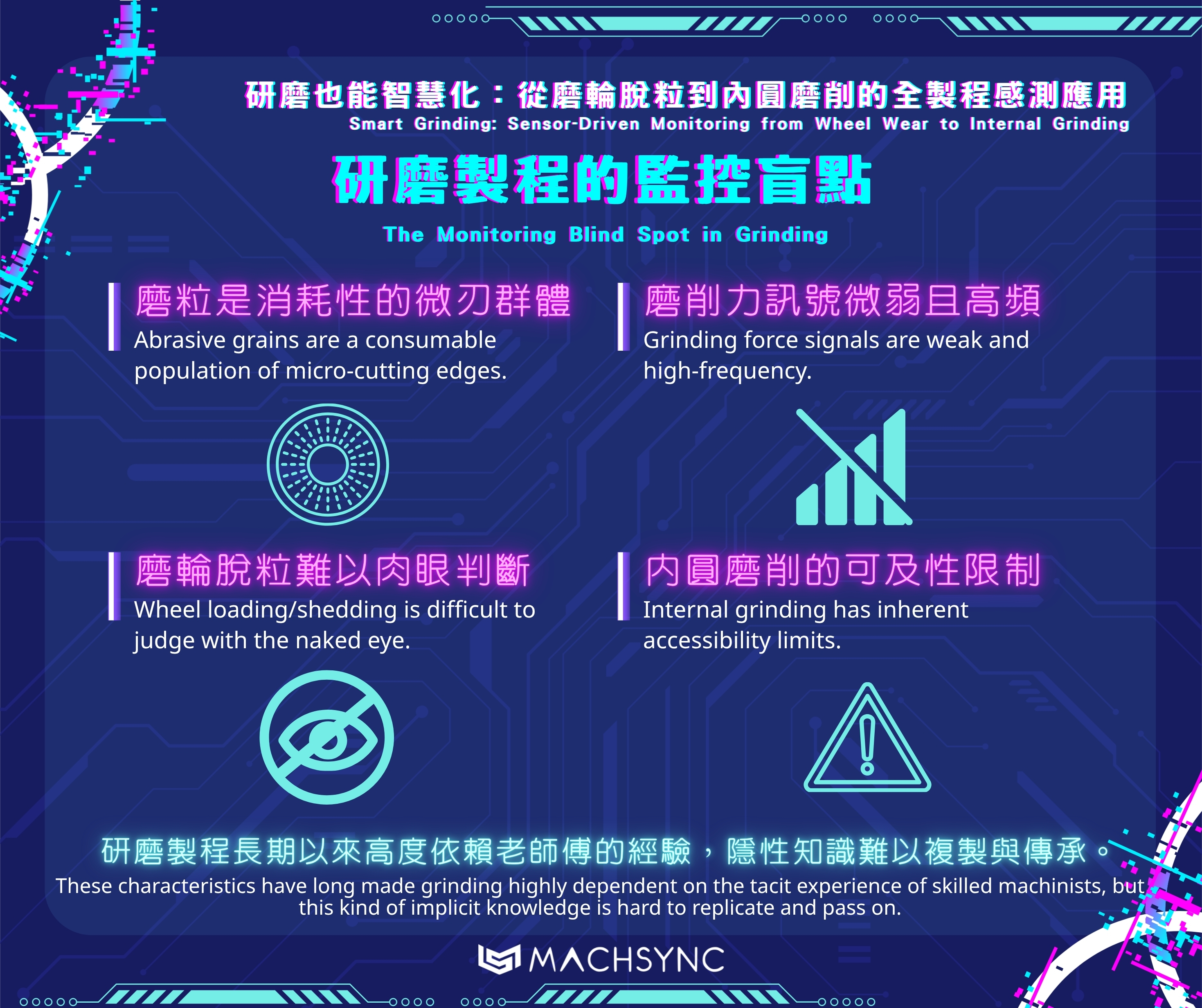
    The Monitoring Blind Spot in Grinding: Harder to "See" Than Milling

    Compared to milling, where tool geometry is well-defined and cutting force signals are regular, grinding has several characteristics that make it inherently harder to monitor:


    • Abrasive grains are a consumable population of micro-cutting edges
      A grinding wheel surface is made up of countless abrasive grains that continuously wear, dull, and shed during machining. The state change is gradual and hidden, unlike a tool breakage that produces a clear, sudden signal.
    • Grinding force signals are weak and high-frequency
      Grinding is a multi-edge, micro-scale cutting process — the force from a single grain is extremely small, and the signal is easily buried in spindle vibration and ambient noise, making it hard for conventional current-based monitoring to pick up subtle changes.
    • Wheel loading/shedding is difficult to judge with the naked eye
      Excessive grain wear without shedding, or uneven shedding rates, can drive up grinding force and cause workpiece burn or dimensional drift — but operators often only discover the problem once a workpiece fails inspection.
    • Internal grinding has inherent accessibility limits
       Compared with external cylindrical grinding, the internal grinding head works deep inside a bore, so operators can't directly observe the grinding condition, and mounting external sensors is difficult, making monitoring even harder.


    These characteristics have long made grinding highly dependent on the tacit experience of skilled machinists — listening for sound, watching sparks, feeling vibration. But this kind of implicit knowledge is hard to replicate and pass on, and it can't support large-scale unmanned production.

    How Sensing Technology "Understands" the Language of the Wheel

    Extending the smart tool holder's sensing architecture to the grinding spindle means recalibrating technology originally used for milling force measurement to fit the signal characteristics of grinding. This mainly covers three areas:


    1. Real-Time Grinding Force Monitoring

    Force sensing modules mounted on the spindle or wheel head capture real-time trends in radial and tangential grinding force. A gradual rise in grinding force usually indicates that the wheel is dulling or that grinding debris is causing loading; an abnormal spike may reflect uneven workpiece material or improperly set feed parameters. By establishing a baseline range for grinding force, the system can proactively alert operators when values deviate from normal — rather than waiting until the workpiece is out of tolerance.


    2. Vibration Signature Analysis

    Wheel imbalance, the surface condition after dressing, and the uniformity of grain shedding all show up as characteristic changes in the vibration spectrum. High-frequency vibration sensing combined with frequency-domain analysis makes it possible to identify early whether a wheel needs dressing, avoiding surface roughness issues or burn risk caused by dressing at the wrong time.


    3. Trending Wheel Condition, Not Single-Point Judgment

    Rather than relying on the absolute value of a single measurement, grinding monitoring depends on trend analysis. By accumulating force and vibration signatures across every machining cycle, a complete lifecycle curve can be built — from a new wheel, through its stable period, to the point where dressing is needed. This shifts dressing schedules from "fixed-interval maintenance" to "decisions based on actual wear condition" — and this is where the real value of smart grinding lies.

    From Wheel Wear to Internal Grinding: Extending Across the Full Process

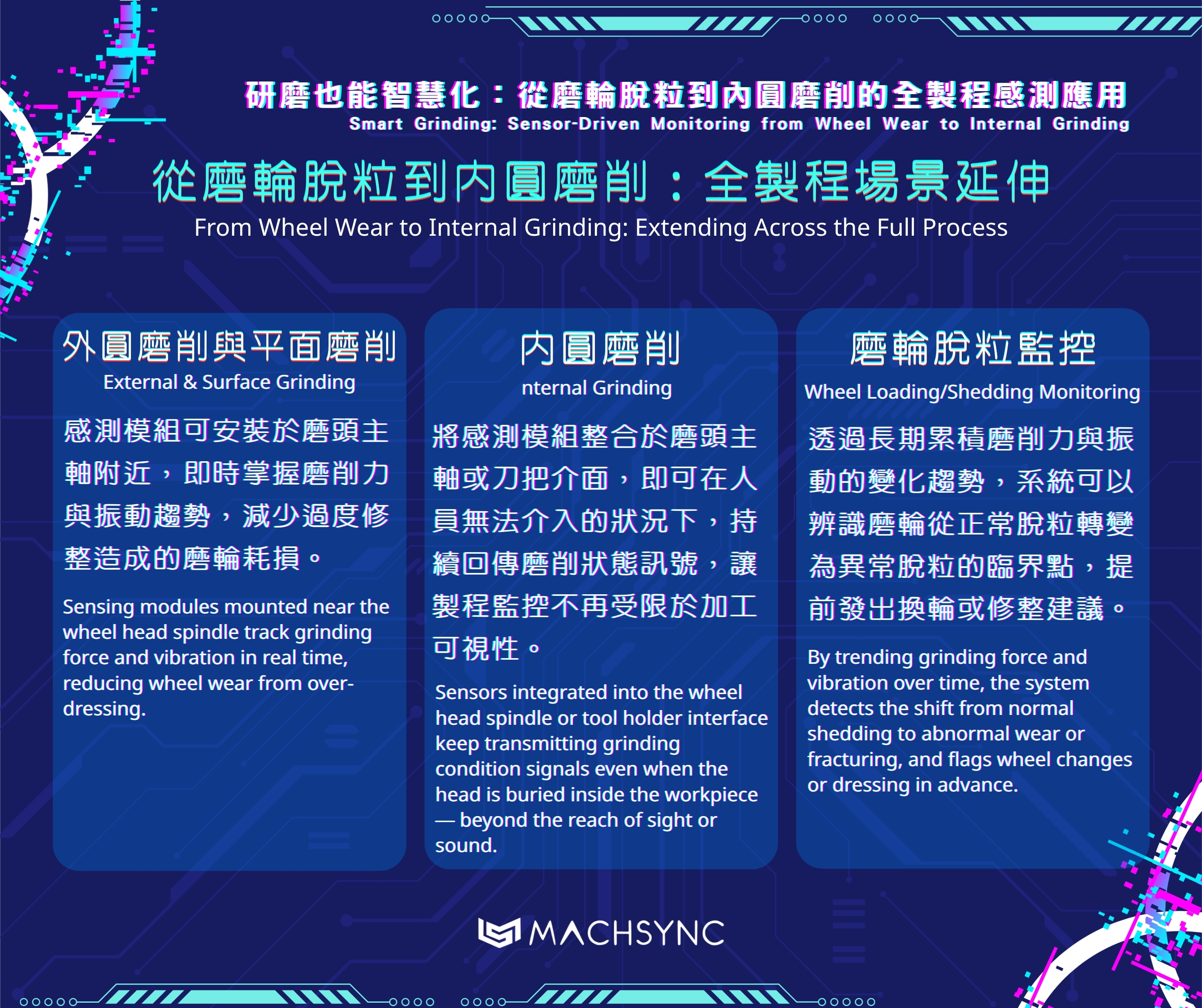
    External cylindrical and surface grinding are the more straightforward applications. Sensing modules mounted near the wheel head spindle capture real-time grinding force and vibration trends, serving as the basis for dressing timing decisions — reducing wheel wear from over-dressing while avoiding unstable surface quality from under-dressing.


    Internal grinding is where sensing technology delivers even more obvious value. Because the grinding head works deep inside the bore, operators cannot visually confirm the grinding condition, and internal grinding typically has lower rigidity than external grinding — making the wheel head more prone to chatter as wheel condition deteriorates, which in turn affects bore roundness and surface roughness. By integrating sensing modules into the wheel head spindle or the tool holder interface, grinding condition signals can be continuously transmitted even when the head is buried inside the workpiece and completely inaccessible to sight or sound — freeing process monitoring from the limits of visibility.


    Wheel loading/shedding monitoring is the common thread running through all these scenarios. By accumulating long-term trends in grinding force and vibration, the system can identify the critical point where a wheel transitions from normal shedding (self-sharpening) to abnormal shedding (excessive wear or fracturing) — issuing a wheel-change or dressing recommendation in advance, and preventing batch defects caused by uncontrolled wheel condition.

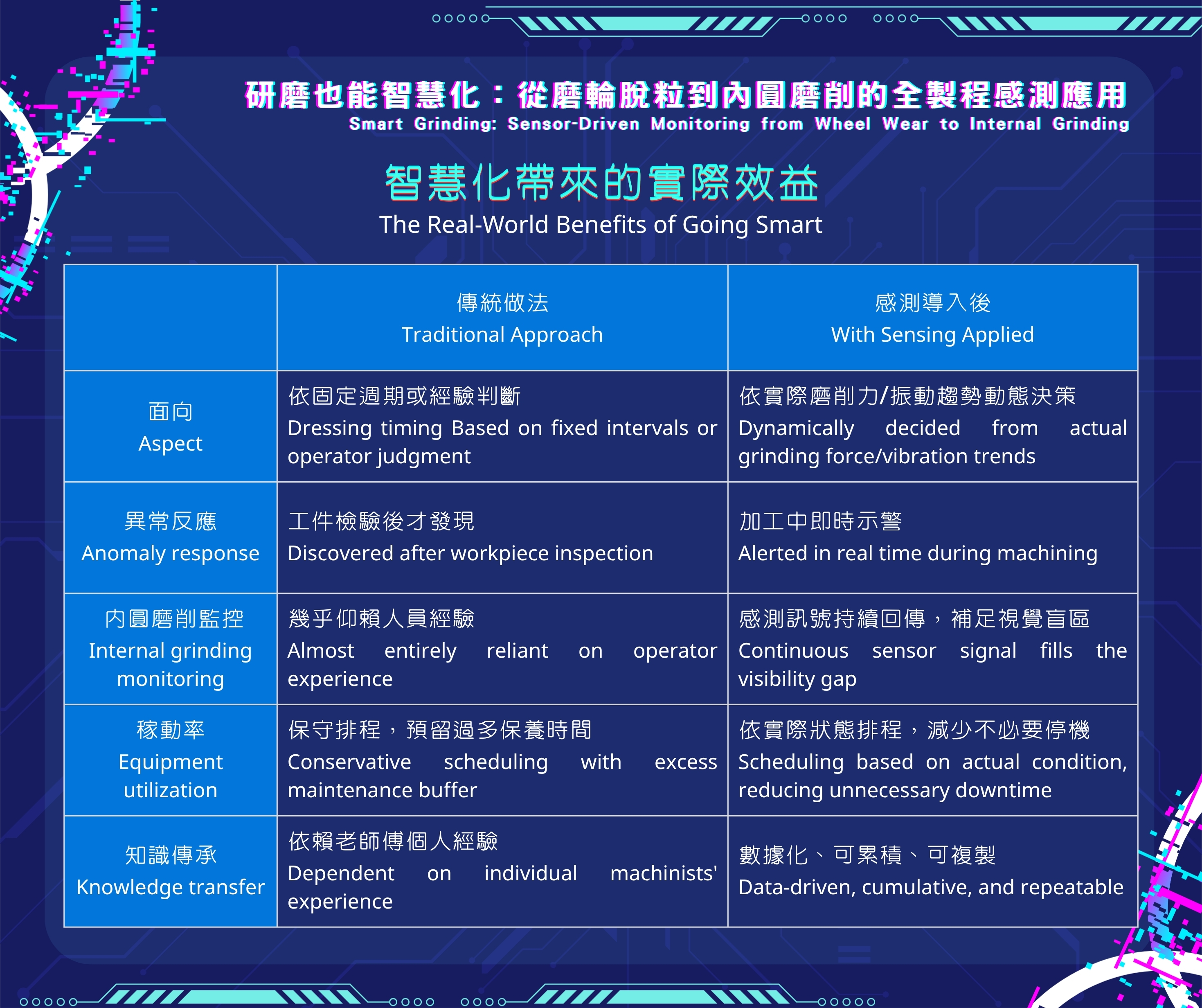
    The Real-World Benefits of Going Smart

    By systematically quantifying and trending signals like grinding force and vibration, the grinding process is no longer a "black box" that runs on experience alone. Like milling, it can now be built on a digital foundation that is monitorable, predictable, and optimizable. This not only helps reduce scrap and rework costs from uncontrolled wheel condition, but also gives equipment utilization gains a data-backed basis — rather than relying purely on conservative maintenance schedules.

    Conclusion

    Extending from milling to grinding, the core value of smart tool holders remains unchanged: turning process conditions on the shop floor that were once "invisible and inaudible" into data the system can understand and act on. Grinding signals are finer and harder to capture than milling signals — but that's precisely why sensing technology delivers such a significant leap in value. From real-time monitoring of wheel wear to filling the visibility gap in demanding scenarios like internal grinding, smart grinding is becoming the next key piece of the puzzle in advancing both quality and efficiency in precision manufacturing.

    Sources: Public domain references

    Photo by Bulat843 / Machsync

    This article is original content created by Machsync. It may not be used for commercial purposes or distributed, shared, or sold in any form. Unauthorized reproduction, excerpting, copying, or use in any visual format is strictly prohibited. 

    For reprint or licensing inquiries, please contact Machsync.

    ﹌﹌﹌﹌﹌﹌﹌﹌﹌﹌﹌﹌﹌﹌﹌

    📬 Get in Touch with Machsync

    📍 2F., No. 38, Keya Rd., Daya Dist. Taichung City, Taiwan

    📞 +886-4-2473-6883

    ✉️ admin@machsync.ai